The Screw You Design Today Is the Recycling Problem of 2030
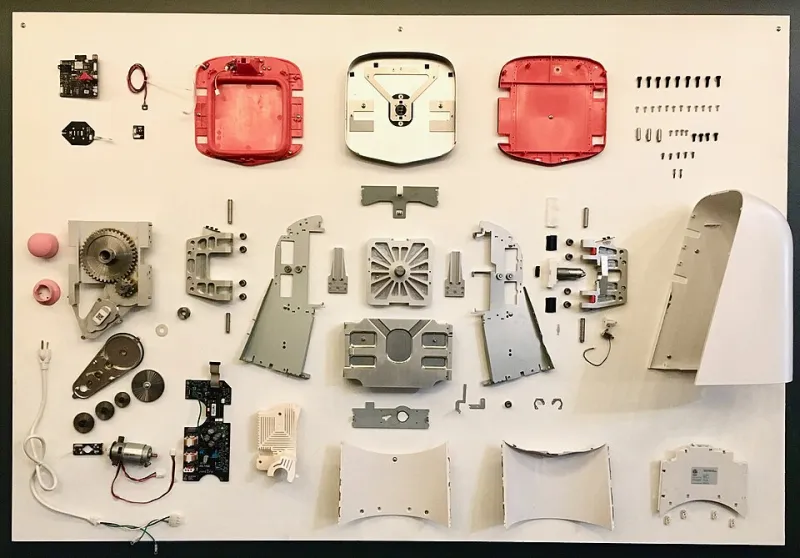
Photo: Steve Jurvetson from Menlo Park, USA, CC BY 2.0, via Wikimedia Commons
A New Stakeholder Joins the Design Review
For most of CAD's history, the assembly model answered one question: can this be put together? A quiet regulatory shift is adding a second question that will matter just as much: can this be taken apart — efficiently, repeatedly, and profitably?
The pressure isn't hypothetical. The EU's right-to-repair directive and ecodesign requirements already dictate spare-part availability and disassembly timelines for entire product categories, and any US manufacturer selling into European markets feels that gravity regardless of domestic law. Closer to home, state-level electronics right-to-repair statutes in New York, Minnesota, and California, plus expanding producer-responsibility rules for packaging and batteries, are pulling the same lever. The recycling line — with its labor costs, cycle times, and shredder economics — is becoming a design constraint the way injection molding draft angles once were.
The Fastener Audit Nobody Wants to Do
Ask a veteran teardown engineer what kills recyclability and you'll rarely hear about exotic materials. You'll hear about fasteners.
The typical consumer product arrives on the disassembly bench carrying five, six, sometimes seven distinct screw types, plus adhesive, plus a welded subassembly nobody documented. Every additional fastener type adds tool changes, added cycle time, added cost — and eventually, added landfill, because a recycling facility that loses money on a teardown will shred instead.
The fix starts in the CAD model, and it's refreshingly unglamorous: run a fastener audit on your assemblies. Count distinct fastener types. Standardize. Then go further and model disassembly sequences explicitly — most modern assembly tools can define explode states and motion paths, and treating those paths as a deliverable rather than a marketing animation forces honest answers about whether a battery can actually come out through a serviceable opening.
Snap-Fits: Design Them for Assembly and Autopsy
Snap-fits get a mixed reputation. Used carelessly, they're a one-way ratchet: brilliant on the assembly line, destructive on the teardown bench. Used deliberately, they're the backbone of design for disassembly.
The difference is whether the release behavior was engineered. A snap-fit designed only for insertion is a hope; a snap-fit with modeled release forces, defined tool access for the release feature, and a documented fatigue life over the intended number of open-close cycles is a design decision. Structural and moldflow simulation can predict both the insertion force and the cantilever's stress state at release — and increasingly, the same nonlinear contact models used for assembly prediction can be run in reverse to verify that disassembly won't shatter the feature on cycle three.
The practical checklist is short:
- Simulate release force and deflection, not just insertion.
- Guarantee tool or hand access to every release feature.
- Specify material pairings that survive repeated flexing at end-of-life temperatures, not just shipping temperatures.
The Digital Twin of the Afterlife
Here's where the digital twin conversation gets interesting. Most twin deployments today track a product through assembly and operation — geometry, configuration, sensor state. Almost none model what happens after the warranty ends, and that's precisely the gap regulation is opening.
An end-of-life twin is a structured record of how a product comes apart: disassembly sequence, fastener inventory, adhesive locations, material callouts per subassembly, and the torque or force data for each release operation. Fed to a recycler, that record turns a teardown from an exploratory exercise into a quoted, plannable process — the difference between paying for disassembly and charging for it. For remanufacturing operations, which are growing fast in the US industrial sector, it's the difference between a viable core-return business and a warehouse of unknowns.
CAD vendors are already moving. Assembly tools are adding disassembly-sequence planning, fastener libraries tagged with sustainability metadata, and bill-of-materials exports designed for recyclers rather than just purchasing departments. PLM platforms are beginning to treat end-of-life data as a lifecycle phase with its own states and deliverables, not a footnote.
Design Like Someone Will Take It Apart — Because Someone Will
The engineers who thrive through the coming decade will treat disassembly as a first-class requirement, specified and simulated with the same rigor as a load case. Start small: audit your fasteners this quarter, model one snap-fit's release behavior, and ask your PLM vendor where end-of-life data lives in their roadmap. The recycling line is coming to your design review. Better to have a seat at the table than a shredder's verdict.